Measure the real-world cost of AI, then do something about it. Free and open source.
The Omnigauge Suite is the flagship of the Stargrain AI Sustainability OS, AIforE's free open source operating system for sustainable AI.
Every AI prompt runs on electricity, water and hardware. Omnigauge tracks AI from a single chat message up to an entire data center. It covers the energy, water, carbon output, air pollutants, noise and habitat impact behind it, so you can see the full picture and act on it. Think of it as a nutrition label for AI, with advice attached.
The open data model and measurement methods. It builds on proven standards wherever they exist, so everyone measures the same way.
Adds a small panel to the AI chat tools you already use. It shows each conversation's tokens, energy, power mix and carbon output, with an option to offset it. It calculates on your own device and never sends the text of your prompts anywhere.
Download the extension (ZIP) · Chrome Web Store and Edge Add-ons: coming soon
The same panel on desktop and mobile, and built into ChatGPT, Claude and Gemini.
Lets developers build the same measurement, panel and Remediate button into their own mobile, desktop and SaaS apps.
Sensors at data centers and in nearby communities. They track power, water, air, heat and noise: what is used, what is released, where it comes from, and what is recycled.
Dashboards shaped to what you need to know. Machine learning shows trends, flags problems early and recommends specific actions.
Try it now: the Token Cost Calculator is a free tool of the Omnigauge Suite. It uses the same methods as the browser extension.
Track the energy, water and carbon output of your own AI use, then choose to offset your carbon impact.
Track the energy, water, carbon output, pollutants and noise linked to your AI features and customers, and hit your sustainability goals.
Get your sustainability operations measured, with verified data on power, water, pollution and community impact. Take programmatic, measurable actions (built into day-to-day operations) to reduce negative impact, and report back transparently to everyone with an interest.
Get timely, transparent data on what nearby facilities consume and how they affect the area, and see each facility's current sustainability score from AIforE (planned). Then choose easy ways to address negative impact through AIforE's solution providers, such as removing CO₂, restoring habitat, deploying renewable energy systems and treating waste water.
Use the Subscriber SDK to show users the real cost of the AI in your app, and let them act on it.
Reach the people and companies who need your work. That includes carbon removal, tree planting, habitat restoration, water treatment and recycling, heat reuse, and clean and renewable energy.
When Omnigauge shows a cost, the Solution Provider Program connects you to a vetted provider who can address it: carbon removal, tree planting and reforestation, habitat restoration, water treatment and recycling, heat reuse, or clean and renewable energy. Our first carbon-removal partner is Sustaera. Providers join through the Stargrain Provider Driver SDK, a standard connection that lists their services, takes orders and reports verified results.
Become a solution provider: hello@aifore.org · How providers connect
We adopt proven, openly available methods where their licenses allow, such as the Green Software Foundation's Software Carbon Intensity standard, ISO data center efficiency metrics and open AI energy benchmarks. We build new methods only where none exist yet: low-frequency noise, habitat baselines before construction, and linking every footprint to verified remediation.
The Omnigauge Suite is open source and vendor-neutral. It's part of our work to make AI and IT sustainable for many generations.
Omnigauge is one part of a larger whole. The Stargrain AI Sustainability OS (Stargrain OS for short) is AIforE's free open source operating system for sustainable AI: a shared set of data, software and services that every part below plugs into.
In the Stargrain OS design, subscriber clients (chat plugins, browser extensions, cloud and database agents) send usage and telemetry through one ingestion API to the Stargrain core. There, it is scored for right-sizing, turned into ROI and return-on-impact figures, and recorded in a net impact ledger for carbon, electricity, water, heat and materials. On the other side, provider drivers connect verified carbon removal and restoration services through one standard interface, and MCP servers give read-only reporting and insights. A subscriber's own eco-positive actions, such as on-site renewables, heat reuse and water recycling, can also earn credit: the EAC Marketplace Plugin turns verified impact into claims listed on environmental attribute certificate (EAC) markets, and the credits and revenue flow back to the subscriber.
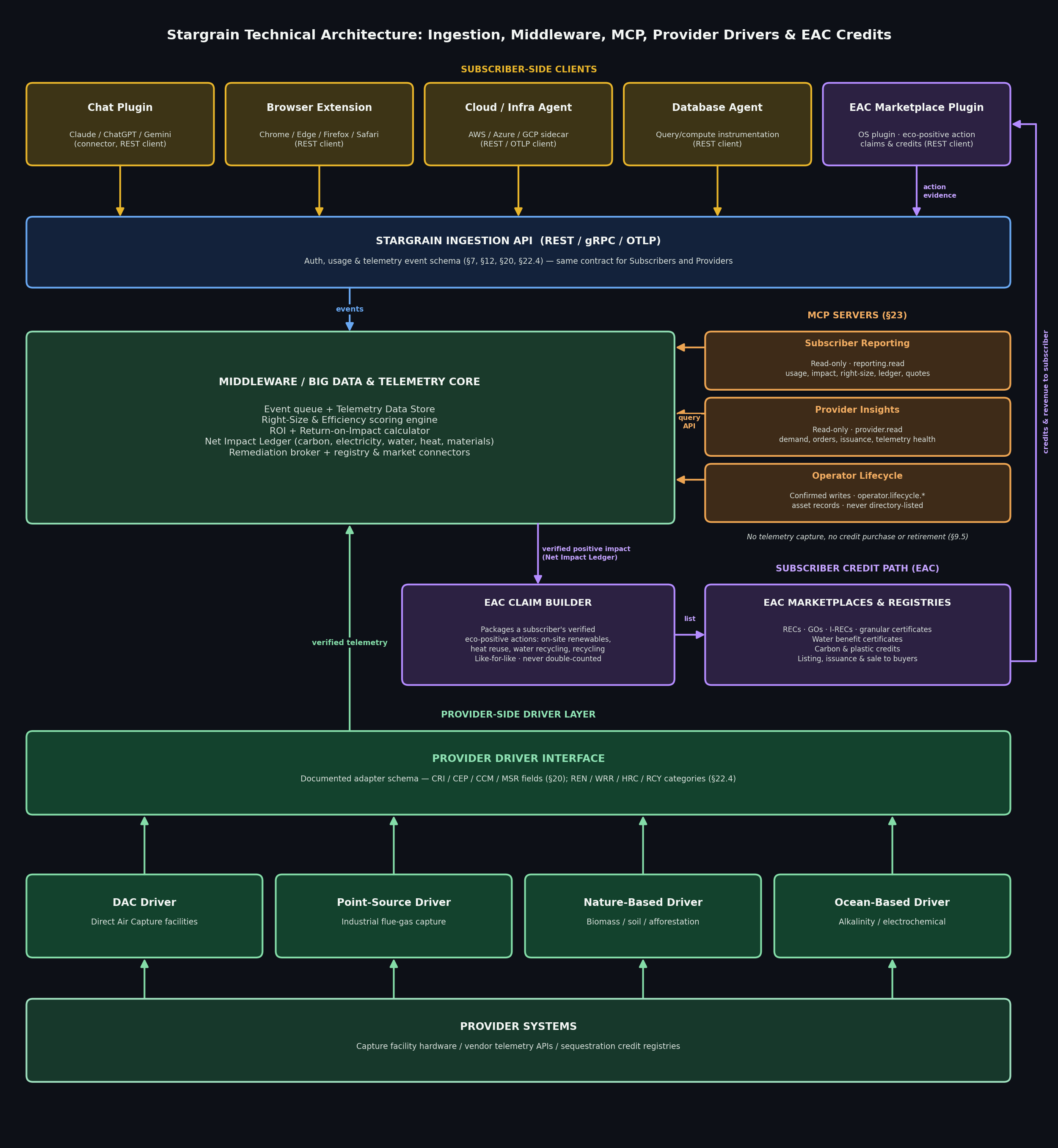
The Stargrain OS has two developer sides, each with its own SDK (software development kit: building blocks a programmer adds to their own software). Both are planned. There is nothing to download yet. To get involved early, email hello@aifore.org.
For sustainability-minded software developers. Adds Stargrain measurement, the Stargrain panel and Remediate to your own mobile, desktop and SaaS apps, so your users can see the real cost of the AI they use and act on it.
For solution providers. A “driver” (a standard plug-in, like the driver that connects a printer to a computer) that plugs your service into the Stargrain OS so users can find it, order it and see verified delivery.
AI's electricity demand is growing exponentially, creating problems and challenges we see every day. Yet no standard, shared way exists to measure what real and evolving AI workloads consume. Today's benchmarks measure peak hardware speed, not the energy real requests use on a real grid at a real time. Every provider reports differently, so buyers, regulators and researchers cannot compare claims or verify efficiency gains. Even organizations that know their footprint have no simple, standard path from measuring it to reducing it and addressing AI's disruptive concerns.
Every AI query has a price tag most people never see: tokens spent, dollars charged, and the electricity, water, and emissions emitted — behind the scenes. That footprint is invisible to most people generating it by using AI services, which means it's invisible to their decisions that could reduce it.
We've built and are improving the Omnigauge Suite, free and open source, to put those numbers back in front of you. Today it runs as the Stargrain browser extension alongside the AI chat apps people already use, including Claude, ChatGPT, and Gemini. For teams running AI at scale, it plugs into the monitoring tools they already use through OpenTelemetry. Wherever a decision gets made, the same figures appear: tokens, cost, energy, water, and carbon, per prompt or per workload.
One glance gives you a compact score; one click shows the full breakdown in plain language. Every figure is labeled as measured or estimated, and our methods are published openly, so anyone can check our work and help improve it.
This is AIforE's ROI in practice: return on investment and return on impact. Omnigauge helps people and companies capture AI's real upside (productivity, speed, quality of life) while giving them what they need to right-size how they use it.
The browser extension, apps and Subscriber SDK are the subscriber side. The other side is the provider: any service that removes carbon or restores ecology. Like a printer driver, a provider implements one standard interface once, through the Stargrain Provider Driver SDK, and becomes available to every subscriber, with no custom integration on either side.
Providers are not limited to carbon. Carbon removal (reforestation, blue carbon, direct air capture, biochar) joins renewable energy generators, water restoration and recycling projects, heat recovery operators, and materials recyclers, all through the same interface. Each is matched to subscribers like for like, by the kind of impact it offsets, and every service has to be carbon negative or otherwise positive for Earth's ecology, in harmony with AI.
A data-center operator can be both: a subscriber consuming electricity and water, and a provider exporting waste heat, generating on-site solar, or recycling water. One SDK covers both roles, and a benefit sold to others is never also counted against the operator's own footprint.
At the center is Stargrain Core. It measures a client's footprint across carbon, electricity, water, heat, and materials, matches it with the providers that can address each one, and connects to the exchanges and registries where credits for each are issued, traded, and retired. The value flowing through those markets, including recycling, helps offset the cost of sustainable operations.
Stargrain never mints its own credits. Recognized programs verify and issue them; Stargrain supplies the measurement data and retires credits in the client's name.
Removal and avoidance credits from registries such as Verra, Gold Standard, ACR, and CAR, with Puro.earth for engineered removals.
Energy attribute certificates: RECs, EU Guarantees of Origin, and I-RECs, plus hourly granular certificates (EnergyTag) as they come online.
Water restoration certificates (BEF, one certificate per 1,000 gallons) and volumetric water benefit accounting, matched within the same or a stressed watershed.
Waste heat delivered for reuse in district heating, greenhouses, or industry, measured with ISO/IEC 30134-6 and credited where white-certificate or carbon programs apply.
Plastic credits (Verra) and e-waste recovery attested by certified recyclers (R2, e-Stewards). There is no mature e-waste credit market yet.
Like for like. A water credit never cancels carbon, and a renewable energy certificate is an electricity claim, not a carbon offset.
One benefit, one claim. Each credit is retired once, for one beneficiary and one claim period.
Match in time and place. Electricity is matched within a market boundary and, where possible, by the hour; water within the same or a stressed watershed; heat to a named local recipient.
Show the confidence. Every provider carries a confidence tier, so a verified registry credit is never presented the same way as an unverified attestation.
This is built in the open as part of the Stargrain AI Sustainability OS, and the Stargrain Telemetry Specification behind it is AIforE's contribution to the field: one open schema for the negative and positive impact of computing, mapped to existing standards rather than competing with them. Many registries don't yet offer open write APIs, so early connectors will retire credits through an account holder and move to automation as registries support it.
About the names: Project Stardust is AIforE's internal code name for this work, which is why the GitHub repository is called stardust. Our open-source products are the Omnigauge Suite, which includes the Stargrain AI app extensions.
Finishing the core plug-in and shipping it free and open source, so any developer or company can build on it.
Portability work across Chrome, Edge, Safari, and Firefox, and integration at the cloud/infrastructure level.
Keeping it free forever for individual users — sustainability tools shouldn't sit behind a paywall.
Every dollar here moves a working, open-source tool closer to release — one that puts sustainability data directly in the hands of the people using AI every day.
AIforE is a 501(c)(3) tax-exempt nonprofit organization. EIN: 42-2272946. Donations are tax-deductible to the extent allowed by law.